
Q4 Inventory on Amazon: How to Stay in Stock When Your Competitors Run Out

Watch the video
Video coming soon. Subscribe to our YouTube channel to get notified.
Find out where your ad spend is being wasted before the busiest weeks of the year. Book a free advertising audit.
This guide covers how to size Q4 inventory on Amazon, the deadlines to plan around, and what to do through December if a SKU is running low, starting with what a fully stocked Q4 looks like for one of our clients.
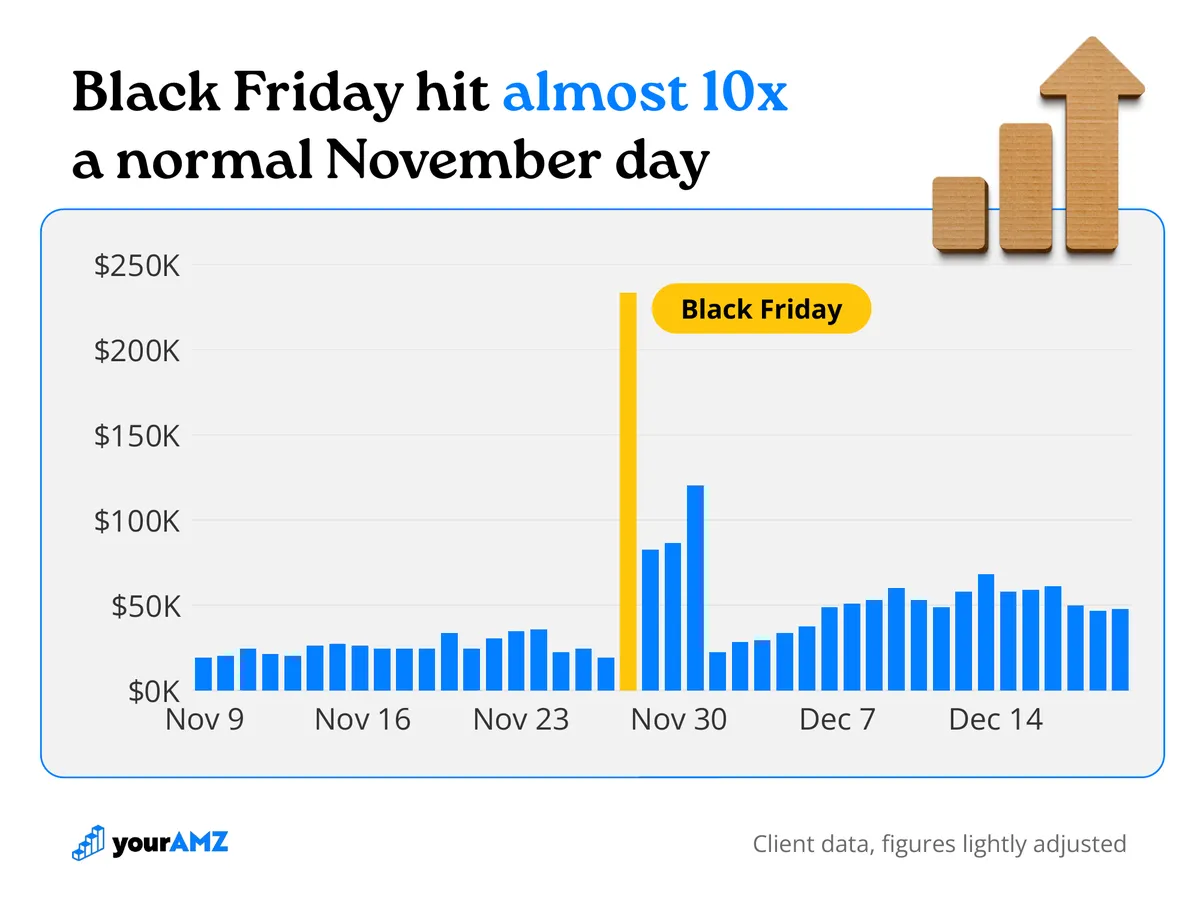
Staying in stock through Q4 matters because of how much demand the season packs into a few days. Last year, that client did almost 10 times its normal daily revenue on Black Friday. Sales stayed at three to five times normal volume through Cyber Monday. You can see the spike in the revenue chart below: the week before Thanksgiving looks flat next to it.
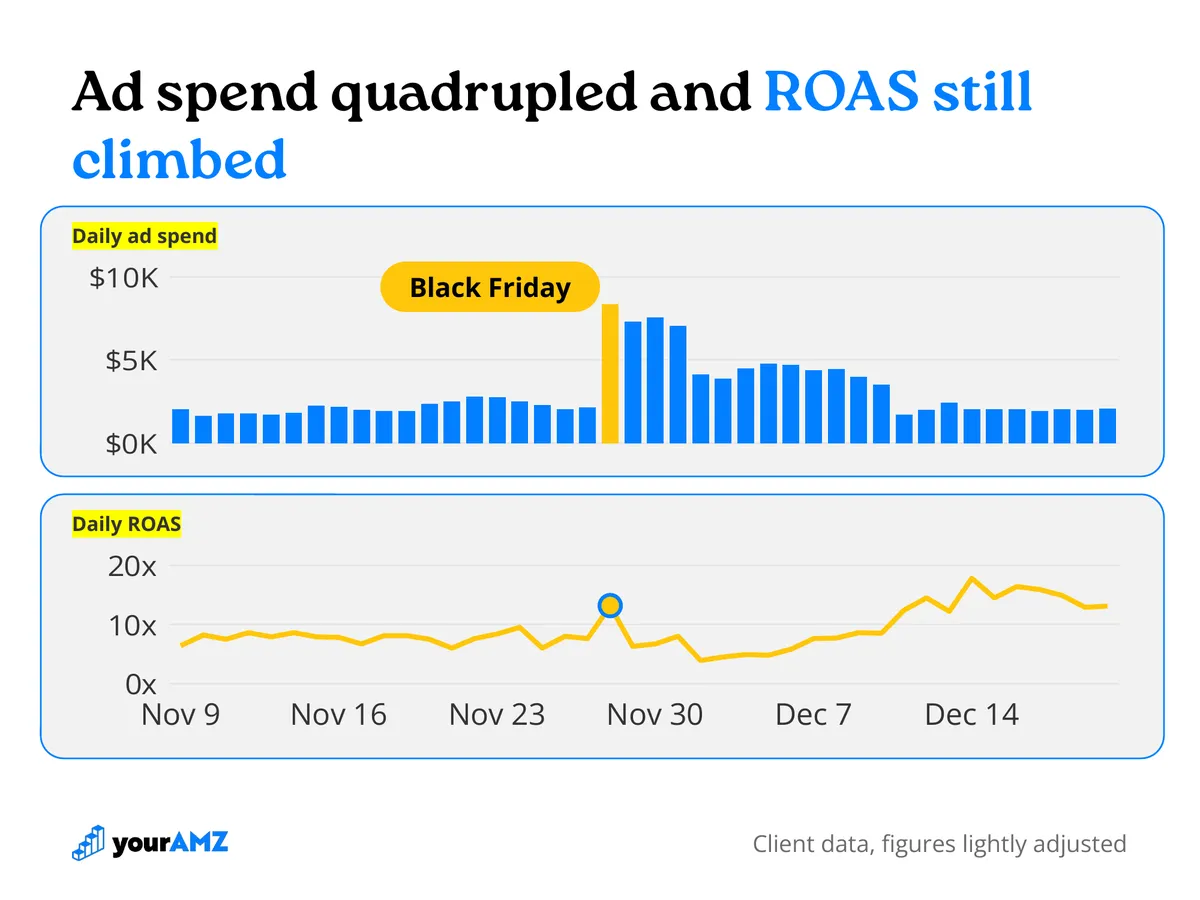
On Black Friday we ran ad spend at about four times its normal daily level, and ROAS still climbed to about 13, roughly 70% above where it sat the week before. Shoppers who are ready to buy convert faster, so each ad dollar bought more sales on the day we spent the most.
That's what Q4 looks like for a brand with fully stocked FBA inventory. Every year, some sellers in your category run out of stock before December, and the brands that still have inventory pick up their shoppers on the highest-converting days of the year.
If you're reading this in November with a SKU running thin, the section on what to do when a SKU is running low is written for you.
Why does staying in stock matter more in Q4?
A Q4 stockout costs you the most sales of the year, and the damage keeps going even after you replenish inventory. Four things happen when a hero SKU runs out between Black Friday and Christmas:
- The peak-day sales are gone for good. A shopper buying a gift on December 12 buys something else that day.
- You give away new customers to competitors. The shopper searching your category clicks the next listing in stock and becomes that brand's customer. You lose the word-of-mouth recommendation that would come from that new customer. If your product gets reordered, you hand over the repeat orders too.
- Your organic rank slips, and January pays for it. Organic rank follows sales. Weeks of zero sales push the listing down, so when stock returns you spend ad dollars buying back your ranking.
- Amazon charges you on the way down. The low-inventory-level fee applies when a product's historical days of supply drops below 28 days on both the 30-day and the 90-day measure. Since January 15, 2026 Amazon measures it per FNSKU, so each color or size is judged on its own stock (Amazon's fee page).
The inventory tab below is from our client dashboard (demo account). The top SKU sells about 98 units per day, roughly $7,300 per day in revenue, and has 18 days of supply on hand.
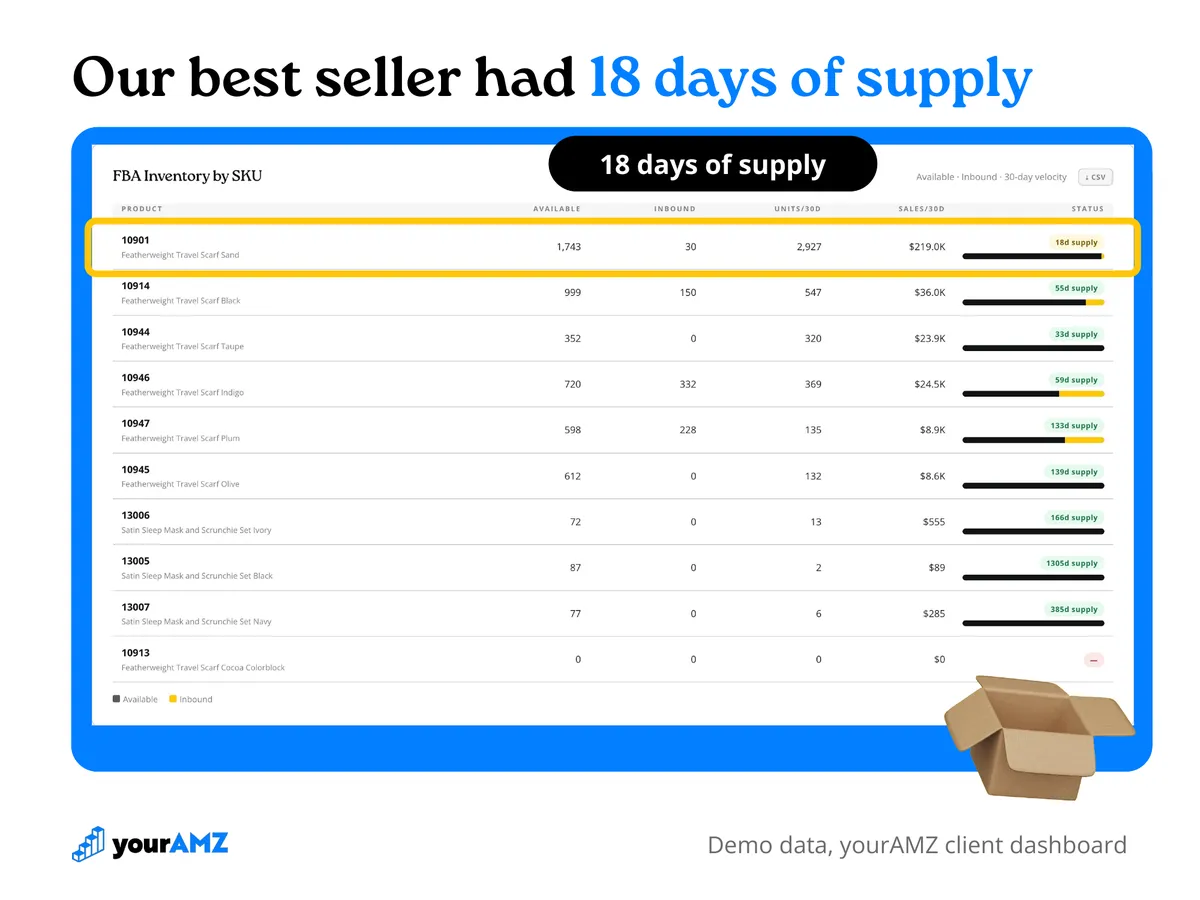
If that SKU ran out on December 10 and the restock landed January 5, that's 26 days at about $7,300 per day: roughly $190,000 in sales at its current pace for a single SKU. December usually runs above that pace, so the real number is bigger. And none of it counts the rank you rebuild in January.
How much inventory do you need for Q4?
Enough to carry each SKU through the end of January, checked in at FBA by Amazon's Black Friday arrival deadline (October 21-28 in 2026). You can still ship to FBA in December, so the rest of the winter can come later. Watch each SKU through Q4 and ship a replenishment in early December so it lands in January. We size the holiday stock in two layers: an account-level sales plan, then units per SKU.
Start with the account plan
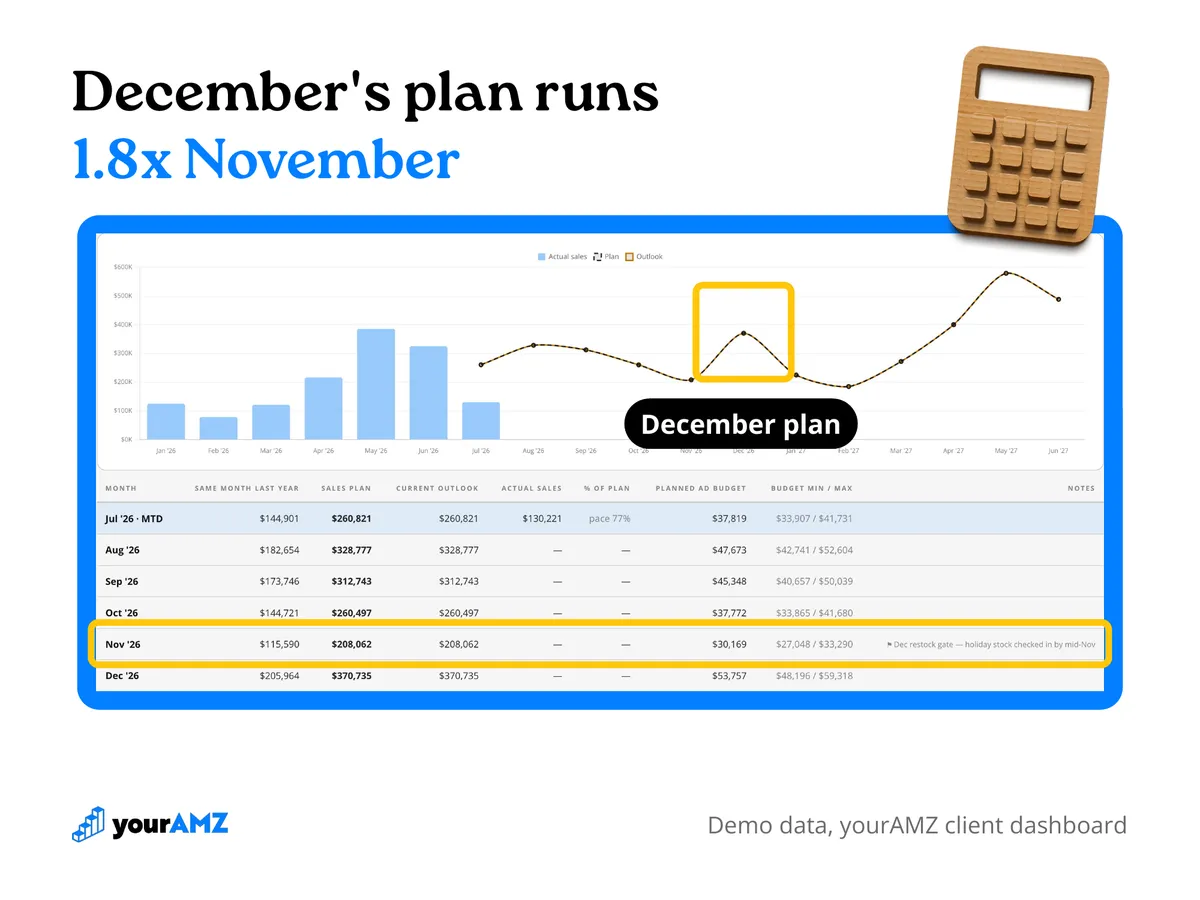
The plan is last year's sales for each month times the growth rate you've agreed for this year. Then adjust it for how the catalog has changed: add the SKUs you launched this year at their current growth rate, and take out last year's sales from any SKUs you've discontinued. That gives you the shape of the season before you look at a single SKU. In the demo account below, December's plan is about 1.8 times November's. The November note covers a late shipment: it landed after Amazon's deadline, so we're watching whether it becomes available at FBA before Black Friday.
Then turn the plan into units per SKU
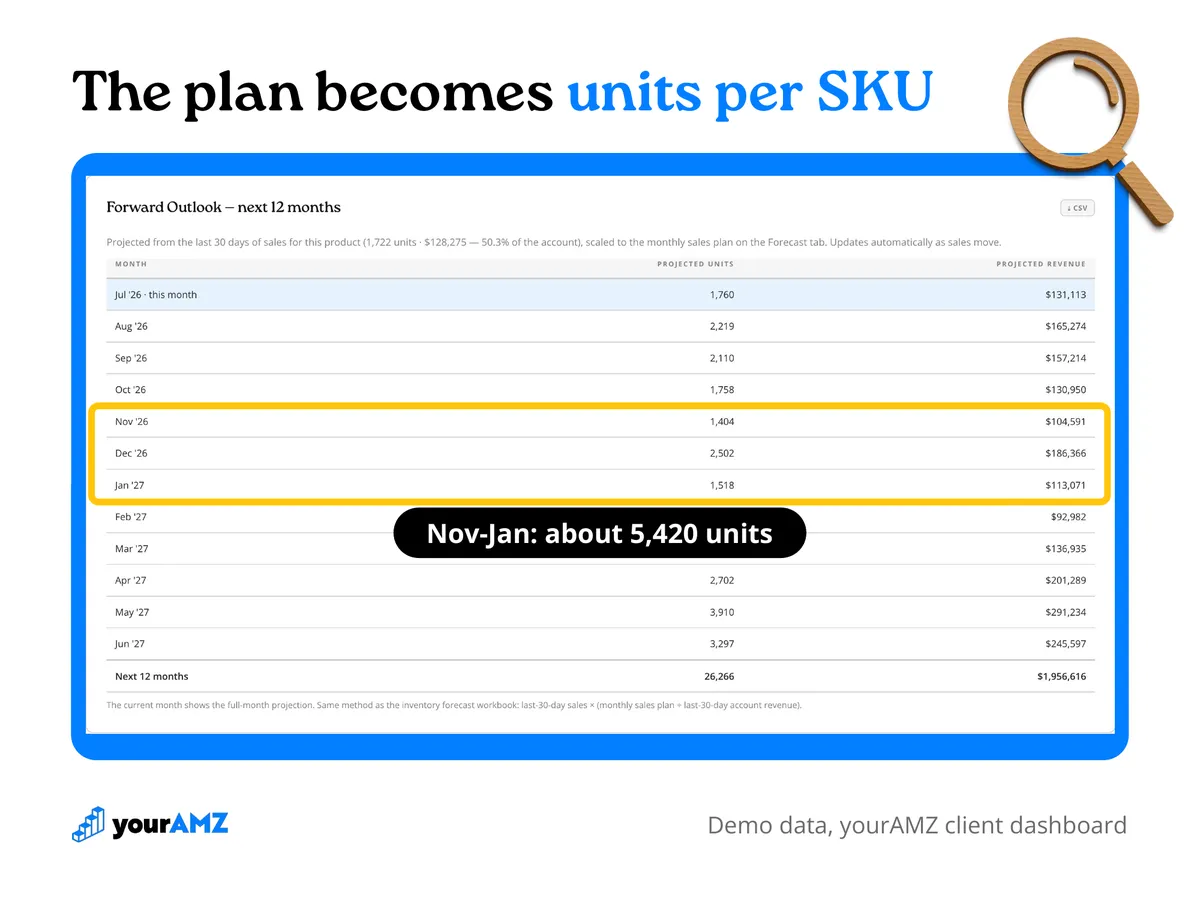
Each SKU's forecast is its share of the last 30 days of sales, scaled to each month of the plan. The table below shows the result for the demo account's best seller: about 1,400 units in November, 2,500 in December, and 1,500 in January.
Forecast each SKU on its own. A parent ASIN with plenty of stock can hide one color that runs out in the second week of December, and the low-inventory-level fee now judges each variation on its own.
The order formula
Units to ship and have checked in at FBA by Amazon's holiday deadline (October 21-28 in 2026) = forecast units through the end of January − units available − units inbound
With the demo SKU: November through January forecasts about 5,420 units. Say the SKU will still have 1,773 units available or inbound at the deadline. That puts the shipment at about 3,650 units, checked in at FBA by Amazon's Black Friday arrival deadline.
Why not stock through February? That would mean four months of inventory plus the holiday lift sitting at FBA. If anything goes wrong, like a slower season or a new competitor, you're overstocked going into the most expensive storage months. A December replenishment lets you size the next shipment from what actually sold in November.
How much is too much?
Below the forecast, you risk a stockout and the low-inventory-level fee. Above it, the cost of overbuying is storage: Amazon's monthly storage rates jump from October through December (Amazon's storage fee page), and units that sit for months pick up aged inventory surcharges.
That risk depends on what you sell. Brands with a strong Q1, like supplements tied to New Year's resolutions or winter-related products, can afford to overstock by about 30 days in Q4. Those units sell in January, when demand is already climbing.
What were the 2026 holiday inventory deadlines?
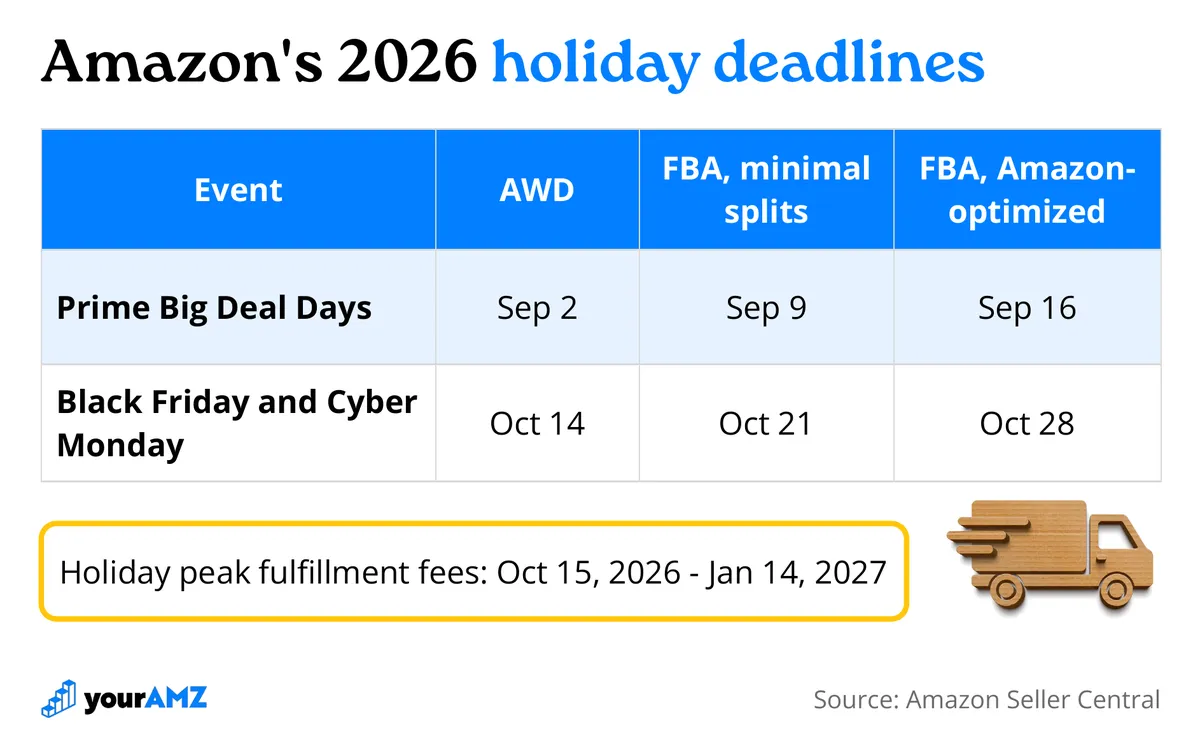
For Black Friday and Cyber Monday 2026, Amazon's arrival dates for FBA inventory were October 21 to October 28, depending on the shipment option you picked in Send to Amazon (Amazon's Holiday 2026 announcement). They sit a month before Black Friday because check-in slows down as holiday volume increases. A shipment that arrives a week before the sale can still be sitting in receiving during Black Friday.
So the decision that's yours is when to ship. Take Amazon's arrival date, subtract your freight and transit time, and that's your ship-by date.
If you missed those dates, shipments still get received, but more slowly, and there's no promise they're sellable before the peak.
Q4 inventory checklist for next year
The brands that walk into Black Friday fully stocked start in the summer. Here's the sequence we run with clients:
- Build the monthly sales plan by August. Last year's months times this year's growth rate, with Q4 and January included.
- Turn it into units per SKU. Every color and size gets its own number.
- Work back from the inbound deadline. Production time, freight, and check-in time all come off the date Amazon publishes. Count backward from the check-in date, since that's when stock becomes sellable.
- Send hero SKUs first. Your best sellers carry the season, so they get the earliest shipments.
- Stock through the end of January, and plan a December replenishment. Have that stock checked in by Amazon's Black Friday arrival deadline, then ship the next round in early December so it lands in January. Add about 30 days if your Q1 is strong.
- Only enter deals your stock can cover. A Black Friday deal on a SKU the forecast can't support sells out the inventory you needed for December.
- Check your stock in mid-November. If a SKU's holiday inventory isn't checked in at FBA by then, start the low-stock plan below.
What to do when a SKU is running low before the holidays
Slow it down on purpose so it never hits zero: cut its ad spend, keep it out of promotions, and send that demand to the SKUs you have in stock. If the SKU is going to sell out either way, there's no reason to burn ad spend or run promotions on it, so every remaining unit sells at full margin. You'll still lose some organic rank when traffic drops for a few weeks, but that's much easier to recover from than weeks out of stock.
It costs you sales in the short term, and for a hero SKU it's almost always the right trade.
How we kept a best-selling accessory in stock
In September, a client's best-selling accessory was selling faster than its next shipment could arrive. We watch days of supply on every SKU daily, and we acted when this one dropped under 30 days on hand.
- Shifted the budget on September 17. We rebuilt the account's campaigns to move the accessory's ad budget to the rest of the catalog.
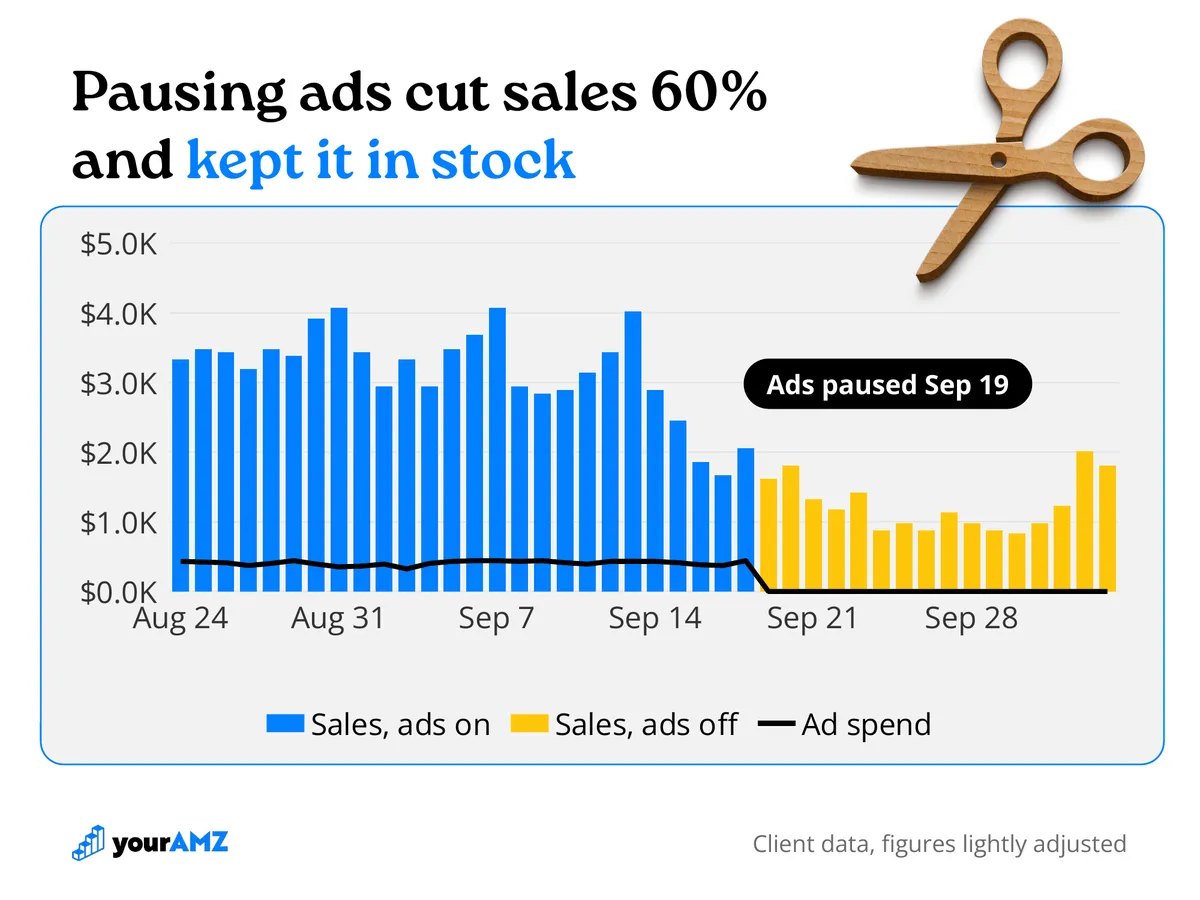
- Paused the accessory's ads on September 19. Its ad spend went from about $410 per day to zero. We went all the way to zero because of when the replenishment was due. If a shipment had already been inbound, we would have reduced the ads instead of cutting them completely.
- Kept it out of every coupon and deal. It stayed out of them for the whole low-stock window, including Prime Big Deal Days in October.
- Turned its ads back on October 6. The restock was sellable about 16 days after the pause, and the ads came back at a smaller daily budget.
While its ads were off, the accessory's sales dropped 60%, from about $3,200 per day to about $1,300. Total account sales fell 8% after the change. The accessory never ran out.
On the accessory's top non-branded search term, its share of purchases fell from about 8% to about 2% while the ads were off. Within four weeks of the ads coming back, it had climbed back to about 6%.
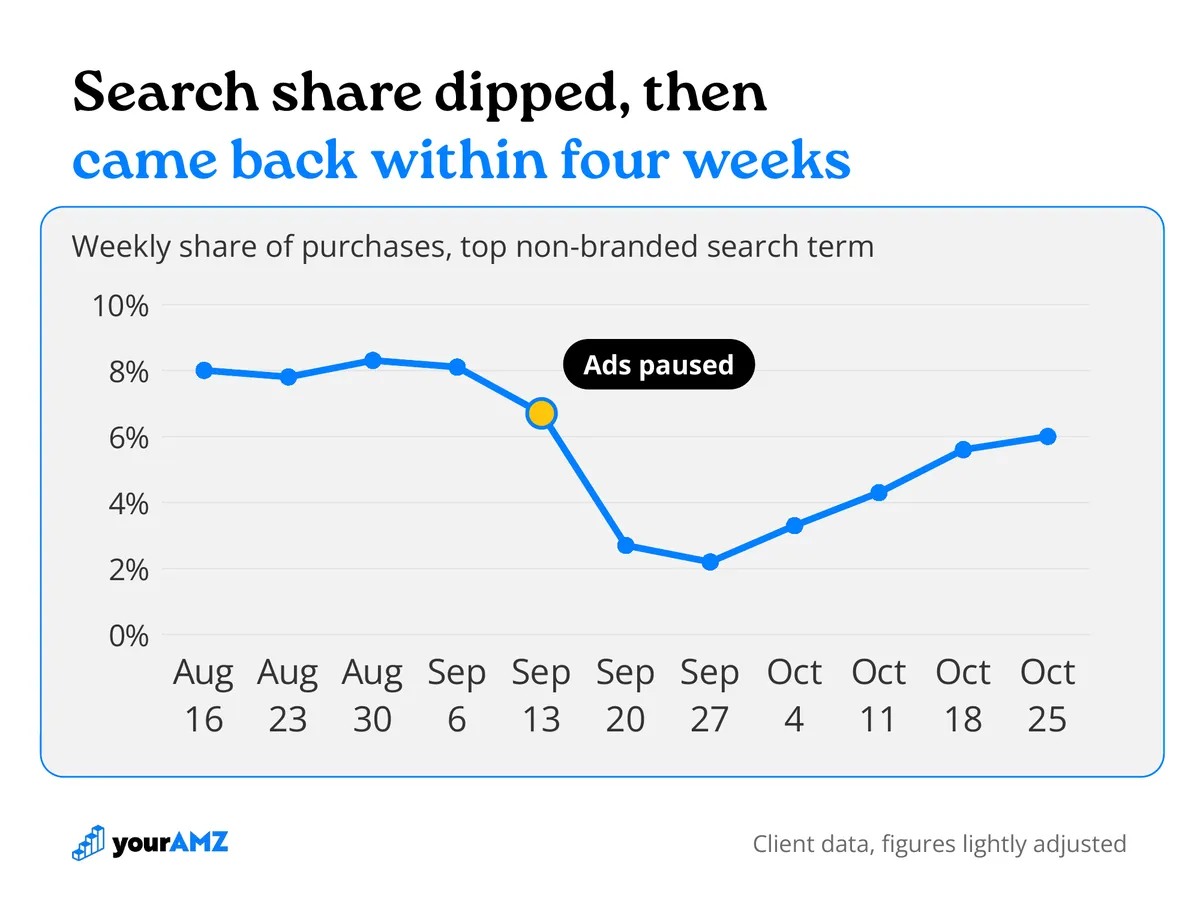
That's the trade: about two and a half weeks of lower sales and a dip in search share the brand is already earning back, against a stockout that would have zeroed its sales until the restock landed, plus the rank loss that comes with it.
The low-stock playbook
- Measure the runway against the December forecast. Days of supply at today's pace overstates it, because December sells faster. Divide units available by the forecast daily units for December.
- Figure out how much to slow down. Compare two dates: the day you'll sell out at your forecast pace, and the day your restock shipment becomes sellable at Amazon. If you have 20 days of stock and the restock lands in 30 days, those units need to last 30 days, so sales have to slow by about a third or more to be safe.
- Cut ad spend, starting with the campaigns that cost the most per sale. Every unit you're going to sell anyway should sell at your best margin. Pull back until the forecast sell-out date moves past the restock date.
- Keep the SKU out of promotions. A Black Friday deal or a coupon sells your last units faster and at a lower margin, which is the opposite of what this SKU needs.
- Send the demand to SKUs you have in stock. Move the budget to other products in your catalog with healthy cover, like the 55-139 day SKUs in the inventory tab above.
- Set up an FBM backup. If you hold stock in your own warehouse or a 3PL, add a merchant-fulfilled offer on the same listing. When FBA runs dry, the listing stays buyable instead of showing "Currently unavailable."
- Ship the restock in pieces. Send the low SKU on its own in the first shipment you can book instead of waiting to fill a full order.
Put simply: if a SKU can't last through December at full speed, slow it down so it never runs out, and make every remaining unit a full-margin sale.
If one of your SKUs is in this spot right now, we run a free advertising audit that shows where your ad budget should go while stock is tight.
Why the brands that stay in stock run inventory and ads as one plan
Most Q4 stockouts happen to brands that didn't forecast their Q4 needs over the summer. Sales outgrew the purchase order, and nobody connected inventory to ad spend until a hero SKU was nearly out of stock and it was too late to act.
We learned this as operators before we were an agency. yourAMZ started in 2016 selling our own products, managing our own inventory, and running a 10,000 sq. ft. Amazon 3PL, so we've seen Q4 from the warehouse floor.
For our clients, inventory, forecasting, and advertising come out of the same plan:
- One sales plan sets both the purchase orders and the ad budget. In the forecast tab above, each month's planned ad budget is a fixed share of that month's sales plan. When the plan moves, both move.
- Days of supply per SKU, updated daily. The inventory tab refreshes every morning from the account's live data, so a SKU heading under 28 days shows up weeks before it hits zero.
- An alert when stock and ads collide. Our monitoring system flags problems like a sold-out variation that keeps driving up ACoS on its campaigns.
A brand that runs it this way walks into December knowing which SKUs can take a Black Friday push and which ones need protecting.
Where to start this week
Here's the first pass to run on your catalog:
- Pull historical days of supply for every FNSKU from the FBA Inventory page in Seller Central.
- Recalculate it for your top 10 SKUs against the December forecast instead of the last 30 days.
- Run the low-stock playbook on any SKU that sells out before its restock becomes sellable.
Some of your competitors won't make it to January in stock, and the brands that do get their shoppers.
If you'd rather have a team run your forecasting, inventory, and advertising as one plan, book a free advertising audit. It's the same audit we run for every brand we onboard, where we find your wasted spend, unprofitable spend, and missed opportunities. We only take three per month.
Client figures in this post are lightly adjusted, and identifying details are changed.
Unlock Your Amazon Potential

Continue Reading

The Money We Found Hiding in Recent Amazon Advertising Audits (and How We Fixed It)